

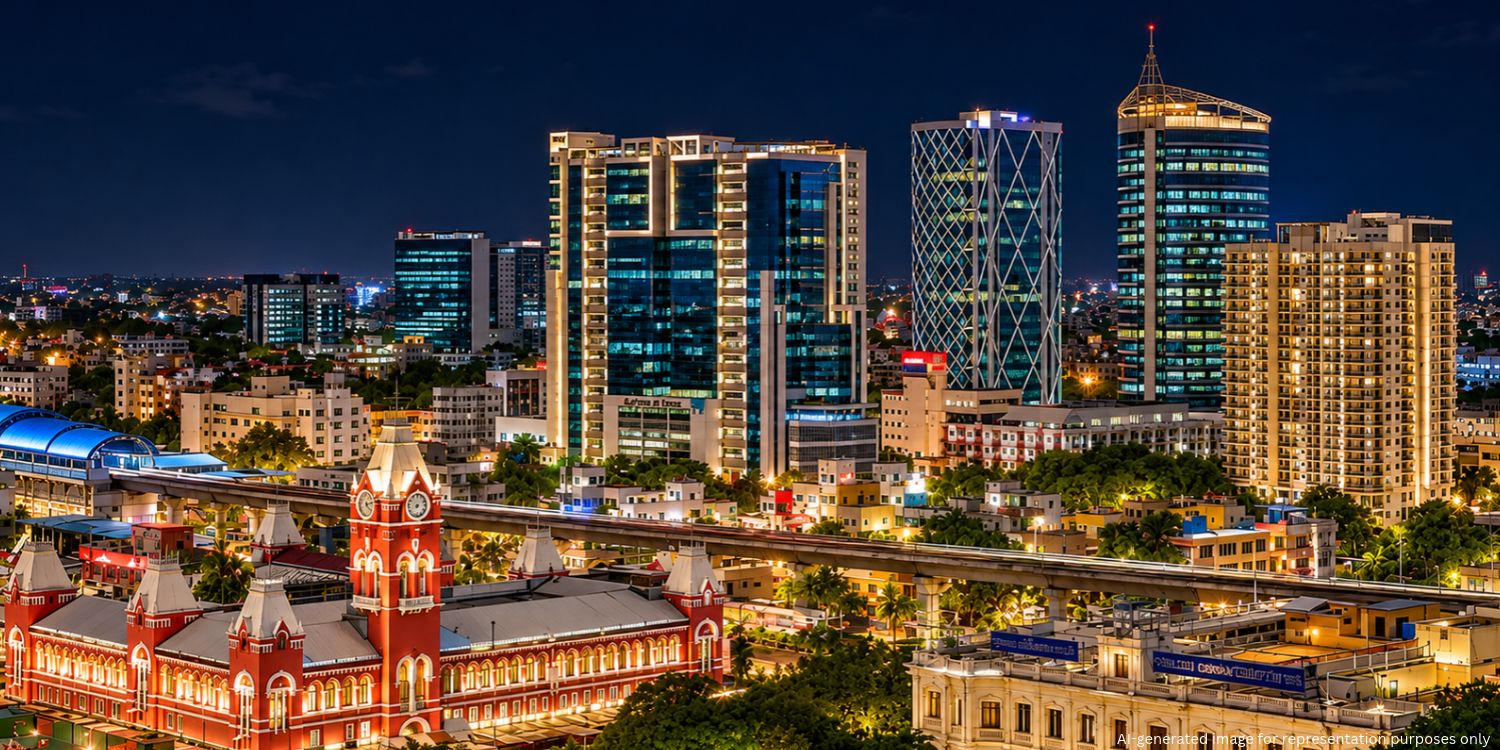
As Chennai continues to expand beyond its traditional urban limits, coordinating development across its growing suburbs has become increasingly important. The Tamil Nadu government has sanctioned ₹45.5 crore to prepare a Comprehensive and Integrated Master Plan for the expanded 5,904 sq. km Chennai Metropolitan Area (CMA). The initiative aims to bring the region under a unified development framework, improving coordination between land use, transport, housing and infrastructure planning.
Why Is Chennai Planning a Unified Metropolitan Framework?
The CMA boundary was expanded in 2022 to include adjoining areas across Chennai, Kancheepuram, Tiruvallur, Chengalpattu and Ranipet districts. However, planning responsibilities remained divided between different authorities and jurisdictions.
The new master plan will combine the nearly completed Third Master Plan for the original 1,189 sq. km CMA with the additional 4,715 sq. km peripheral region. This will establish a common long-term development framework for the entire metropolitan area.
The proposed planning exercise covers three distinct jurisdictions:
- 1,189 sq. km: Existing CMDA planning area.
- 1,617 sq. km: Local planning areas under the Directorate of Town and Country Planning (DTCP).
- 3,098 sq. km: Areas currently outside any formal planning jurisdiction.
What Challenges Does the Expanded CMA Face?
Despite the 2022 expansion, differences in planning jurisdictions have created challenges for coordinated urban development. Several peripheral towns, including Maraimalai Nagar, Ponneri, Tiruvallur and Arakkonam, are experiencing residential and industrial growth without corresponding improvements in civic infrastructure.
The absence of formal planning in large parts of the expanded region also creates concerns around construction near lakes, water catchments and coastal aquifers. These issues affect suburban residents, daily commuters and developers dealing with different planning and approval frameworks.
How Will the New Master Plan Improve Regional Development?
The integrated framework is expected to coordinate development across transportation, economic activity, housing and environmental management. Its proposed focus areas include:
- Transport and connectivity: Better regional connectivity, integrated transit planning and coordinated infrastructure networks.
- Housing and economic development: Planned residential areas, employment opportunities and clearly defined economic corridors.
- Water and environmental protection: Conservation of water bodies, wetlands and coastal aquifers, alongside groundwater replenishment.
- Climate resilience: Improved planning for flood management, coastal protection and climate adaptation.
Suburban residents and commuters stand to benefit from better-planned infrastructure and transport connections. Industrial and logistics operators could gain from organised economic corridors and improved port and highway connectivity. Formal real estate developers may also benefit from more consistent zoning and Floor Space Index (FSI) regulations.
From the Third Master Plan to a Wider Metropolitan Vision
The ongoing Third Master Plan for the original 1,189 sq. km CMA provides an important foundation for this larger exercise. Its scope includes land use, employment, housing, open spaces, shoreline development, urban heat management, blue-green infrastructure and disaster preparedness.
The new initiative extends this planning approach to the expanded metropolitan region, drawing on studies and planning inputs already developed by CMDA, DTCP and other agencies. This will help connect the existing urban framework with the development requirements of the surrounding districts.
What Is the Implementation Timeline?
The government issued the administrative sanction on November 11, 2026, increasing the initial budget announcement of ₹25 crore to ₹45.5 crore. The funding will be released over three financial years:
- 2026-27: ₹10 crore
- 2027-28: ₹22 crore
- 2028-29: ₹13.5 crore
CMDA will appoint an internationally reputed planning consultant through global competitive bidding. A Tender Scrutiny Committee, Expert Review Committee and a High-Level Steering Committee headed by the Chief Secretary will oversee the selection and review process.
A Long-Term Framework for Chennai's Expansion
The ₹45.5 crore allocation marks an important step towards coordinated development across the expanded Chennai Metropolitan Area. By bringing previously fragmented planning jurisdictions into a common framework, the initiative aims to address infrastructure gaps, support economic activity and strengthen environmental protection.